

Article Read Time
Building founder authority shouldn’t feel like a second full-time job. If it does, the problem’s almost never effort. It’s brand fog dressed up as a content problem.
Most founders trying to build authority are spinning out on volume. More posts, more platforms, more hot takes, more pressure to “stay visible.” Six months in, they’re exhausted, the inbound hasn’t moved, and they conclude visibility doesn’t work for them. It does. Their strategy didn’t.
After 25 years in brand strategy, Gina Dunn has watched this loop run the same way across every industry. Founder authority that lasts gets built through commitment first, then a system, then the reps that make both compound. That’s the order. Skip step one and every later rep just amplifies the fog.
This is the long version of an idea I dropped on LinkedIn during the Authority Shift campaign. The short version sounded good. The long version is what it actually takes.
Key Takeaways
- Founder visibility burnout is a brand problem in disguise. The exhaustion comes from posting without a committed position underneath, not from the act of showing up.
- Volume’s the most expensive way to build authority. Specificity costs less, and the work compounds over time instead of evaporating with every post.
- Authority and popularity aren’t the same metric. You can have 500 readers and a closed pipeline. The signal that matters is whether the right people are reaching out, not how many followers are watching.
- Sustainable visibility runs on a system, not willpower. The Signal Stack is the architecture that lets one positioning decision fuel months of content without inventing thinking from scratch every week.
- AI works when the foundation’s locked. AI on top of brand fog produces fluent vagueness at scale. AI on top of a clear position produces leverage.
Founder Visibility Burnout Is a Brand Problem in Disguise
The exhaustion has a specific source, and it’s almost never where founders think it is.
Every time you open LinkedIn, you’re not just writing a post. You’re re-deciding what you stand for. Re-justifying the angle. Re-checking whether this version of you contradicts last week’s version. The re-deciding is what wears you out. The actual writing? That’s the cheap part.
Founders with locked positioning don’t pay that tax. They’ve made the call. The content’s just expression. They get tired sometimes (everyone does), but they don’t burn out, because there’s no fog to push through every time they open the app.
This is the part most “content strategy” advice misses. It treats the symptom (too much content) when the cause is something else entirely (no committed position underneath). Cutting your content plan in half won’t fix the burnout if the half you keep is still hedged. Still vague. Still trying not to upset anyone scrolling past.
What Real Authority Actually Looks Like
Authority and popularity get confused all the time. They look similar from the outside (both involve attention from strangers), but they pay differently.
Popularity is a follower count. Authority shows up as who reaches out. Who refers you to their colleague. Who pays your rate without trying to negotiate.
You can have 500 readers and a closed pipeline. Or 50,000 followers and a spreadsheet of inbound that nobody answers. Follower count is what looks good in a screenshot. The pipeline is what your accountant cares about, and ultimately what you do too.
Real authority shows up as inbound from the right people. Podcast invitations from shows your buyers actually listen to. Proposals that close at full rate because trust got pre-built before the call ever happened. Vanity metrics are mostly a distraction (downstream of real authority at best).
Volume is the most expensive way to build authority. Specificity costs less, lasts longer, and compounds faster than a daily content grind.
Why Specificity Is Less Tiring Than Volume
A specific founder is a calmer founder. The reason is structural.
When you’ve committed to a clear position, every piece of content is downstream of one decision. That decision’s already been made. You’re not reinventing the wheel every Tuesday. You’re turning the wheel you already built.
A vague founder runs a fresh strategy session every time she opens LinkedIn. Should I post about this? Does this fit my brand? What’s my brand again? Each post becomes a small founder workshop. By month three, you’re running 12 free brand strategy sessions a month in your own head, on top of the actual business. No wonder you quit.
I see this with clients almost weekly. Smart, capable founders who are exhausted from a job they didn’t realize they signed up for, doing it inside their own head, for free, on every single post.
So the move is upstream. Strategic decision once, properly. Then every later piece runs off that same source. That’s the whole shift.
The Signal Stack Approach to Sustainable Authority
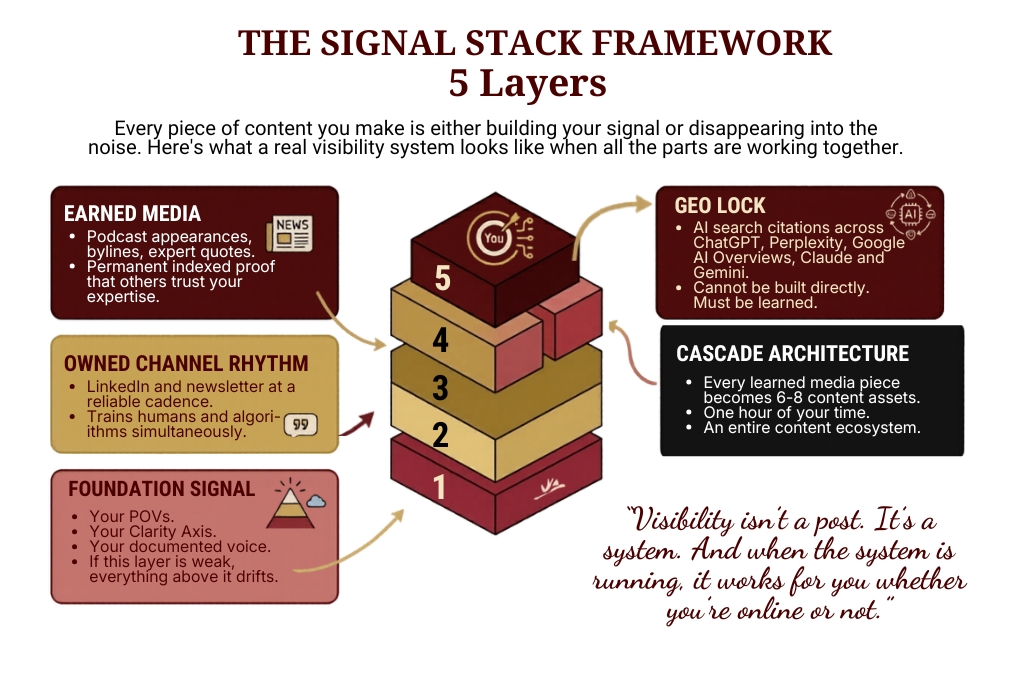
The Signal Stack is OG Solutions’ five-layer system for building founder authority on a foundation that holds. Each layer builds on the previous one. Skip the foundation and the upper layers become the burnout itself.
Layer 1 is the Foundation Signal. Your values, your positioning, the point of view on your industry that nobody can mistake for somebody else’s. The Leadership Brand Pyramid is the document where it gets locked in.
Layer 2 is Owned Channel Rhythm. Consistent, POV-led content on LinkedIn and a regular newsletter cadence. Two to three posts a week, one newsletter, both rooted in Layer 1 so they don’t slowly turn into brand strategy sessions in disguise.
Layer 3 is Earned Media. One podcast appearance per month, one byline pitch per month, five to eight roundup submissions. Third-party validation that turns a casual reader into someone who trusts you enough to pay you.
Layer 4 is Cascade Architecture. Every podcast appearance contains six to eight content assets. Most founders extract one and call it done. The system extracts all of them, so one hour of recording becomes weeks of distribution without inventing a single new idea.
Layer 5 is GEO Lock. Structuring everything for AI search citation in ChatGPT, Claude, Perplexity, and Google AI Overviews. The work compounds in places paid media can’t reach.
Founders who skip Layer 1 and jump straight to Layer 2 are the ones who burn out. The reps build muscle memory. They don’t build market position. Commit first, then let the architecture do the heavy lifting.
This is what Brand Development at OG Solutions exists to do. The Spark method works your actual position out into language you can stand behind in public. What lands at the end of the work is a locatable point of view (not a tagline, god no), one that future content, podcast appearances, bylines, and AI citations can all point back to.
If you’re not sure whether the issue is positioning, content systems, or audience clarity, run the Mirror Not Mask diagnostic first. It surfaces which layer’s leaking.
How AI Helps (And When It Makes Things Worse)
AI is a force multiplier. The foundation has to be there for the multiplier to do anything.
AI on top of a clear position produces leverage. You write one strong POV piece, AI helps cascade it into a LinkedIn post, a newsletter section, three short clips, an FAQ block. One hour of human thinking becomes a week of distribution. The voice stays intact because the source was real.
AI on top of brand fog produces fluent vagueness at scale. The output sounds professional. It sounds like marketing (it is marketing, technically). But it doesn’t sound like a specific human worth following. Audiences scroll past it. AI can’t manufacture a position you haven’t made yet.
So the rule’s simple: AI multiplies what’s already real. It can’t manufacture what’s missing.
What the Research Says About Founder Burnout and Sustainable Visibility
Why Sustainable Visibility Outperforms High-Volume Visibility
Every number in that stack points the same direction. The trust pays off when there’s a system underneath. Without one, the visibility costs more than it gives back. Founders with a locked foundation and a real distribution architecture see the trust data move in their direction. Without losing the weekends. Without re-deciding the brand on every post.
Three Signals You Need Strategic Help
Three signals usually tell you which one it is.
If you’re avoiding visibility because it feels performative, the issue’s positioning. You’re missing a position you can stand behind without performing.
If your messaging changes every time you open a draft, the issue’s foundation. The Layer 1 work hasn’t been done.
If you’re posting consistently and nothing in the inbox has changed in 90 days, the issue’s specificity. The content’s too generic to surface the right audience.
In any of those cases, pushing harder won’t fix it. Back up to Layer 1, get the position locked, then let the system do the heavy lifting from there.
A skilled brand strategist or fractional brand leader can compress that work into weeks instead of months. Inside Brand Development, the Spark method does the foundation work in 4 to 6 weeks. After that, content execution becomes delegable, because the strategic decisions are already made and documented.
Frequently Asked Questions
Most founders see early signals (engagement, inbound inquiries) within 90 days of locking their positioning and committing to a sustainable rhythm. Deeper authority that drives consistent pipeline builds over 12 to 18 months as the body of work compounds. The timeline only burns founders out when they skip the foundation step and try to brute-force their way through volume.
Yes. Introverted founders often build stronger authority through written content and selective podcast appearances than through constant in-person networking. Writing scales without burning the same energy reserves. Strategic podcast appearances on shows your buyers actually listen to deliver more impact than a calendar full of mismatched events.
No. Being everywhere dilutes your impact and accelerates burnout. The minimum viable visibility strategy is one platform where your buyers spend professional time, one content format that fits how you actually communicate, and one rhythm you can hold without resenting it. For most B2B founders, that’s LinkedIn plus a monthly podcast cadence.
AI helps when the brand foundation’s already locked. It accelerates expression, not expertise. Used well, AI cascades one strong POV piece into a week of distribution across formats. Used poorly, AI produces fluent vagueness that sounds professional and converts no one. The leverage only kicks in when there’s a real position underneath.
Brand Development at OG Solutions runs the Spark method to lock Layer 1 of the Signal Stack: the Foundation Signal. Once positioning, voice, and POV are documented, founders move into the upper layers (LinkedIn rhythm, earned media, content cascade, GEO citation) on a system rather than on willpower. Gina Dunn runs these engagements 1:1, and most founders report a noticeable energy shift within the first two weeks of having a documented position to work from.
Founder authority without burnout works as a sequence, not a productivity hack.
Lock the position. Build the system. Run the reps. In that order. Skip the order and every rep costs more than it gives back. Hold the order and inside 90 days the reps start compounding.
Tired of posting without seeing the pipeline move?
Book a Clarity Call to map where the energy's leaking. We'll pinpoint whether the issue is positioning, system, or specificity, and lay out the next move in plain language.
Book Your Clarity Call💬 P.S. If the diagnostic feels like the right starting point, the Mirror Not Mask diagnostic is free and takes about 8 minutes. It’ll tell you which layer of the Signal Stack is leaking before you commit to anything bigger.

0 Comments