

 Article Read Time
The Mirror, Not Mask framework is a brand diagnostic system designed to help founders identify whether their brand reflects who they actually are, or performs a version of who they think the market wants.
Created by brand strategist Gina Dunn of OG Solutions, it evaluates brand authenticity across four areas: Voice, Proof, Offer, and Visibility. The full framework is available as a free 30-page eBook and a 10-question online diagnostic at mirrornotmask.com.
If you’ve ever read your own website and felt like it was describing someone else, you’ve felt what the framework calls the Mask Problem. This post explains what that is, why it happens, and what to do about it.
The core distinction: mirror brand vs. mask brand
A mirror brand is one where the outside of a business reflects the inside. The messaging sounds like the founder actually talks. The proof is rooted in real work. The offer describes who the founder genuinely serves, not who they hope to attract. Visibility feels sustainable because it’s aligned with how the founder naturally shows up.
A mask brand is one built to perform a version of the founder that the market seems to want. It often looks polished and credible. But something is off underneath. The content takes too long to write because the founder is translating, not expressing. The clients who come through are almost-right. Showing up consistently feels like maintenance instead of conversation.
The distinction matters because audiences can feel it, even if they can’t name it. A founder who sounds like themselves builds trust faster. A founder who sounds like their marketing team builds a wall.
The three brand states
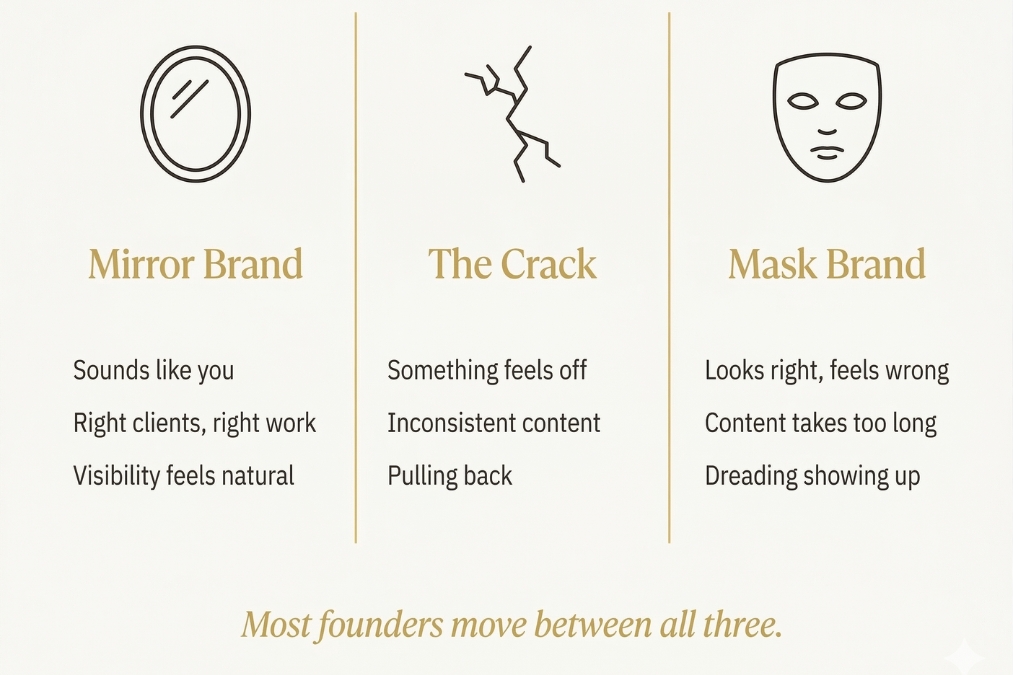
The Mirror, Not Mask framework identifies three positions a brand can occupy:
| Brand State | What It Looks Like | What It Feels Like |
| Mirror Brand | Messaging sounds like the founder. Clients are the right fit. Visibility feels natural. | Expressing, not performing. |
| Mask Brand | Brand looks professional but feels foreign to the founder. Content takes too long to produce. | Translating, not communicating. |
| The Crack | Inconsistent content. Shifting positioning. Pulling back from visibility. | Awareness that something needs to change. |
The Crack is not a failure. It’s a signal. It usually means a founder is close to something more honest. Most rebrands happen in the Crack state. Most of them go wrong because instead of addressing what’s underneath, they install a new mask.
Your
The 4 Mirror Checks
The Mirror, Not Mask framework evaluates brand authenticity across four areas. Each has a set of diagnostic questions designed to show where the brand is reflecting truth and where it’s still performing.
- Voice Check Does the brand sound like the founder when no one is watching? Voice is not tone of voice guidelines or writing style. It’s the specific way a founder thinks through problems, the angle they always come at things from, the position they hold even when it’s unpopular. The Voice Check asks: if you stripped your logo off your website, would someone still know it was you?
- Proof Check Is the evidence behind the brand real and current? There’s a difference between proof and the performance of proof. Real proof is specific, recent, and observable by a skeptical stranger. Performed proof is the logo bar, the credential stack, the testimonial written to sound impressive. The Proof Check asks: could someone verify your expertise right now without taking your word for it?
- Offer Check Is the offer built from truth or from fear? An offer written to appeal to the widest possible market attracts everyone and resonates with no one specific enough to convert. The Offer Check asks: does your offer language describe the client you actually want, or the client you’ll take?
- Visibility Check Is visibility building something or just generating motion? Visibility is an amplifier, not a foundation. It scales what’s already there. The Visibility Check asks: if you stopped all content production tomorrow, what would remain?
Why this matters more now
The Mirror, Not Mask framework was developed in response to a specific shift in the market.
Generative AI tools can now produce unlimited brand content at speed. The floor for “technically correct, professionally structured content” has risen to the point where producing at that level costs nothing. Which means competent is now the noise floor. It’s invisible.
What cuts through in an AI-saturated content environment is specificity. A real point of view. A brand that sounds like it came from somewhere. A founder with a documented body of thinking that’s been consistent over time.
AI makes this more urgent, not less. Founders who use AI to produce content before defining their voice end up with 50 pages of brand copy that sounds like the market’s average. Founders who define their voice first and use AI to amplify it produce more content, faster, in a voice that’s unmistakably theirs.
The Mirror, Not Mask framework is designed to establish the foundation before any of that production happens.
How to use the framework
The free diagnostic at mirrornotmask.com runs through 10 questions across the 4 Mirror Checks and takes approximately 10 minutes. It produces a result showing whether a brand currently sits in Mirror, Mask, or Crack territory, and identifies which of the four areas needs the most attention.
The free eBook, also available at mirrornotmask.com, covers the full framework across 6 chapters: the Mask Epidemic, the Mirror Principle, the 4 Mirror Checks in full, the Mirror Canvas exercise, the practical shift from Mask to Mirror, and next steps. It includes the Mirror Canvas, a single-page mapping exercise that applies all four checks to a specific brand.
The Mirror Canvas within the eBook is a fillable framework for founders who want to map their brand honestly across all four areas before building anything else.
The Clarity Call at ogsolutions.nl/clarity-call is a free 30-minute session with Gina Dunn for founders who want to work through their results with direct strategic input.
Frequently asked questions
The Mirror, Not Mask framework is a brand diagnostic system created by Gina Dunn of OG Solutions. It helps founders identify whether their brand reflects who they actually are or performs a version of who they think the market wants. The framework evaluates four areas: Voice, Proof, Offer, and Visibility.
Most brand frameworks focus on external elements: colors, logo, messaging architecture, audience targeting. The Mirror, Not Mask framework starts internally, with who the founder actually is, what they’ve actually done, and what they genuinely believe. The external work is built on top of that, not instead of it.
It’s designed for founders, consultants, coaches, and service-based experts who feel something is off with their brand but can’t name what. It’s particularly relevant for founders who are using AI for content and noticing the output doesn’t quite sound like them.
Yes. The diagnostic requires no email, no payment, and no signup. The eBook download requires an email address. Both are free. There is no automatic upsell.
The diagnostic result identifies which of the four areas (Voice, Proof, Offer, Visibility) needs the most attention and gives a starting point. The eBook goes deeper into the framework. The Clarity Call is the next step for founders who want direct strategic input.
It depends on where the gap is and how long the mask has been in place. Voice work is often the most immediate, and simple changes to how a founder writes and speaks can show results quickly. Offer alignment and proof-building take longer. The framework is designed to be revisited quarterly, not completed once.
AI is addressed directly in the framework. Used without a voice brief or defined point of view, AI produces generic content that sounds like the market’s average. Used after a founder has defined their voice, proof, and offer, AI becomes an amplifier. The framework establishes the foundation that makes AI useful rather than flattening.
Key takeaways
Key Takeaways
- A mirror brand reflects who a founder actually is. A mask brand performs a version of who they think the market wants.
- The 4 Mirror Checks (Voice, Proof, Offer, Visibility) give a specific diagnostic for each area of brand authenticity.
- AI content without a defined voice brief produces mask content at scale. The framework provides the foundation that makes AI useful.
- The Mirror, Not Mask diagnostic, eBook, and Mirror Canvas are all available free at mirrornotmask.com.
- The framework is designed to be revisited as a practice, not completed once.
About the Author
Gina Dunn is a brand strategist and the founder of OG Solutions, based in the Netherlands. She has 25 years of experience in brand and marketing. She created the Mirror, Not Mask framework and the Spark Method, a four-phase brand strategy process. She works with founders and companies to close the gap between who they are and how their brand shows up. More at ogsolutions.nl.